
Thru-Feed Vibratory Tubs: Continuous-Flow Inline Finishing Systems
- Home
- /
- Equipment
- /
- Vibratory Tub Finishing Machines
- /
- Thru-Feed
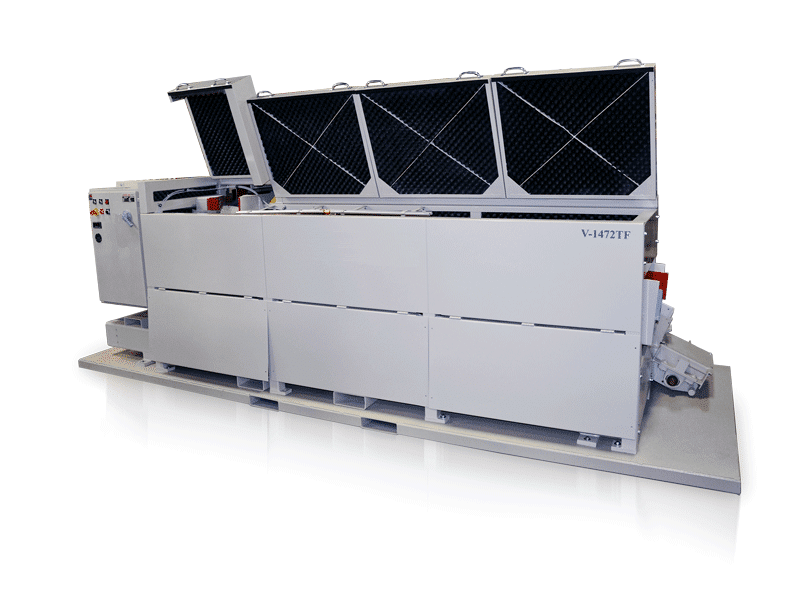
No Batching. No Waiting. Parts Go In One End and Come Out Finished at the Other.
Most vibratory tubs are batch machines: load, run, stop, unload, and repeat. The Thru-Feed eliminates this cycle by processing parts continuously. Parts enter from upstream operations and move through the vibrating tub to the discharge end, exiting fully finished. An integrated separator removes media, a fines deck clears contaminants, and a return conveyor recycles media back to the inlet.
The result is a conveyor-like finishing system that runs nonstop. Parts can be fed at short intervals and exit at the same rate, eliminating batch downtime. For high-production operations, this removes finishing as a bottleneck.
Available in 8 models from 6.5 to 62 cu ft, with tubs up to 239″ long and motors from 7.5 to 50 HP, the Thru-Feed scales from moderate to high-throughput finishing applications.
The Continuous Finishing Cycle: Part Entry to Finished Exit
Here’s the material flow through a Thru-Feed system:
- Part entry: Parts are fed into the inlet end of the tub—manually, by conveyor from an upstream operation, or through an optional automated loading mechanism. The tub is already filled with media, water, and compound. Parts enter the existing tumbling mass and immediately begin processing.
- Finishing travel: The vibratory action moves parts through the tub from inlet to outlet. Parts and media tumble together, with media contacting every part surface as the batch travels the length of the tub. The longer the tub, the longer the finishing time—tub length is effectively the cycle-time control. An optional adjustable tub pitch angle can further tune travel speed.
- Oscillating parts-media separator: At the discharge end, parts and media flow onto an oscillating screener unit with a urethane-lined body and replaceable plastisol-coated woven-wire screen. The oscillation separates parts from media by size—parts pass over the screen, media falls through.
- Secondary fines deck: Below the primary separation screen, a secondary deck screens the media again to remove fines, broken media, metal chips, and other contaminants before the media is returned to the tub. This keeps the media clean and extends its working life.
- Media return conveyor: The screened, cleaned media travels up a return conveyor and re-enters the tub at the inlet end. The media loop is fully automatic—no manual media handling, no stopping to refill the tub.
- Finished part output: Parts exit the separator onto a collection bin, downstream conveyor, or directly into a washer, dryer, or rust-inhibiting station. The system is designed to integrate with downstream operations just as it integrates with upstream ones.
The entire process runs without stopping. Parts enter continuously and exit continuously. The machine doesn’t pause between batches because there are no batches.
Thru-Feed System Features
|
Integrated oscillating parts-media separator Not an add-on—the oscillating separator is built into the system. It separates parts from media continuously as they exit the tub, using a urethane-lined body and replaceable plastisol-coated woven-wire screen. This is what makes continuous operation possible—without integrated separation, someone would have to manually sort parts from media at the exit. |
Secondary fines removal deck Below the primary separator, a second screening deck removes broken media, metal fines, and contaminants before media re-enters the tub. In continuous operation, media degradation accumulates faster than in batch processing because the media is in constant use. The fines deck keeps media quality consistent without manual inspection. |
|
Media return conveyor Cleaned media is automatically conveyed back to the tub inlet. The media loop is fully closed—no manual refilling, no stopping to add media between parts. This is the feature that turns the Thru-Feed from a long vibratory tub into a complete finishing system. |
Variable amplitude + variable speed Control both the aggressiveness of media contact (amplitude) and the travel speed of parts through the tub (speed). In continuous operation, these controls determine how much finishing each part receives during its transit time. Longer transit = more finishing. Faster speed = higher throughput. The operator balances these based on the part’s finishing requirements. |
|
Steel media capable Like the V Series, the Thru-Feed is built to run steel media for burnishing and surface hardening applications. The heavy-duty polyurethane lining and reinforced construction handle the density and impact forces of steel balls and pins in continuous operation. |
Adjustable tub pitch angle (optional) Tilting the tub from inlet to outlet changes how quickly parts travel through the finishing zone. A steeper angle increases throughput (faster transit, less finishing per part). A shallower angle slows transit for more aggressive finishing. This gives operators a third process variable beyond speed and amplitude. |
Thru-Feed Tub Basic Operation
Continuous Thru-Feed Vibratory Finishing Tubs operate by feeding parts directly into the machine at short intervals from preceding operations. Material handling systems remove any foreign particles in the media, and parts separate from the media on the oscillating screener unit. The media falls to the secondary deck, which again screens media to remove any foreign particles or contaminants. The screened media then travels up the return media conveyor to re-enter the vibratory processing tub.
Available Thru-Feed Models
| Model | Tub Cap Cu Ft. | Tub Length | Tub Width | Motor HP (Variable Speed) |
Overall Dimensions (In.) |
| V-1472TF | 6.5 | 72″ | 14” | 7.5 | 176 x 58 x 78 |
| V-14156TF | 17.5 | 156″ | 14” | 10 | 300 x 73 x 117 |
| V-1696TF | 13 | 96″ | 16” | 15 | 270 x 60 x 118 |
| V-19114TF | 22 | 114″ | 19” | 15 | 272 x 70 x 120 |
| V-16155TF | 20 | 155″ | 16” | 20 | 314 x 73 x 129 |
| V-19229TF | 43.5 | 229″ | 19” | 40 | 500 x 99 x 161 |
| V-23189TF | 48 | 189″ | 23” | 40 | 370 x 84 x 135 |
| V-23239TF | 62 | 239″ | 23” | 50 | 375 x 107 x 130 |
Batch Processing vs. Continuous Flow: Which Approach Fits Your Production?
|
Factor |
Batch (V Series / VB) |
Continuous (Thru-Feed) |
|
How Parts Move |
Load batch → run cycle → stop → unload → reload |
Parts enter continuously → travel through tub → exit finished |
|
Cycle Time |
Fixed per batch (e.g., 20 min) |
Continuous — determined by tub length and travel speed |
|
Downtime Between Batches |
Yes — load/unload time between each batch |
None — no stopping between parts |
|
Throughput |
Limited by batch size x cycles per shift |
Limited only by part feed rate |
|
Media Management |
Manual — operator manages media between batches |
Automated — separator + fines deck + return conveyor |
|
Integration |
Standalone batch station |
Inline with upstream (machining, stamping) and downstream (washing, coating) |
|
Part Mix Flexibility |
High — easy to change media and process per batch |
Lower — optimized for one part type running continuously |
|
Best For |
Mixed-part shops, multiple processes, moderate-to-high volume |
Single-part high-volume lines, transfer lines, maximum throughput |
Choose Thru-Feed if you produce one part type (or a small family of similar parts) at high volume, your production line runs continuously and you need finishing to keep pace, batch changeover time is a throughput bottleneck, or you want finishing integrated inline between machining/stamping and downstream operations like washing and coating.
Choose a batch machine (V Series) if you run multiple different part types through the same finishing machine, you need to change media and process parameters frequently, your production is job-shop style with varying order sizes, or your finishing requirements are complex enough to benefit from per-batch process control.
What the Thru-Feed Is Built For
High-Volume Automotive and Stamping Production
Automotive stamping operations produce thousands of parts per shift from progressive dies and transfer presses. Every stamped part has burrs, sharp edges, and die marks that need to be removed before assembly or coating. A batch vibratory machine can process these parts, but the load-run-unload cycle introduces downtime between every batch. The Thru-Feed eliminates this: parts can be conveyed directly from the press to the Thru-Feed inlet, travel through the tub, exit deburred and separated from media, and continue to the next station—without a single batch changeover.
Transfer Line Integration
The Thru-Feed is designed to fit into existing transfer lines and production flows. Upstream operations (machining, stamping, casting, forging) feed parts to the Thru-Feed at whatever interval they produce them. Downstream operations (washing, drying, rust-inhibiting, coating, inspection) receive finished parts at the same rate. The Thru-Feed becomes one station in a continuous production flow, not a standalone island that requires dedicated operator attention.
The system can be equipped with washer, dryer, and rust-inhibiting stations at the exit end, creating a complete finish-wash-protect sequence in a single inline system.
Steel Media Burnishing at Scale
For operations that run steel media burnishing (surface hardening, peening) at high volume, the Thru-Feed provides continuous processing that batch machines can’t sustain. Steel media is automatically separated, cleaned through the fines deck, and returned to the tub—maintaining media quality across hours of uninterrupted operation.
Who Buys the Thru-Feed
- Automotive OEMs and Tier 1 suppliers with high-volume stamping, machining, or casting operations that need inline finishing to keep pace with production throughput.
- Heavy equipment and appliance manufacturers producing large quantities of formed, stamped, or machined components that all require the same finishing process.
- Fastener manufacturers processing thousands of screws, bolts, or pins per hour where batch processing would create an impossible bottleneck.
- Operations replacing multiple batch machines running in parallel. A single Thru-Feed system can replace two or three batch machines by eliminating changeover time and running continuously.
Are You Interested in the Thru-Feed Vibratory Tub?