
RF-20: The Smallest Centrifugal Disc Finisher in the RF-Series
- Home
- /
- Equipment
- /
- Centrifugal Disc Finishing Machines
- /
- RF-20 Centrifugal Disc Finisher
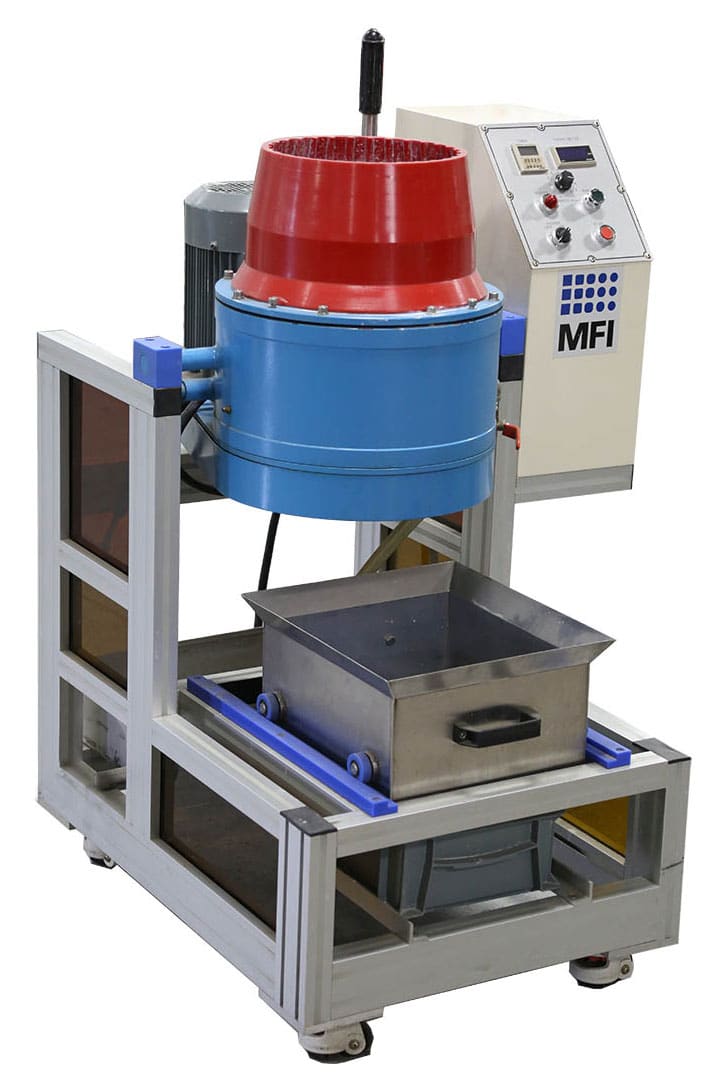
High-Energy Disc Finishing in the Smallest Footprint: 33″ x 33″, 0.7 Cu Ft
The RF-20 is the smallest centrifugal disc finisher from Mass Finishing—and the most accessible way for a small shop, lab, or production cell to add high-energy finishing. At 33″ x 33″ (under 8 sq ft) and 575 lbs, it fits the footprint of a small vibratory tumbler but finishes parts 10–30x faster.
Centrifugal disc finishing differs from centrifugal barrel finishing. Instead of sealed rotating barrels, the RF-20 uses an open-top tub with a spinning disc. This creates a toroidal flow pattern—parts and media move up the walls and down through the center—driving high-energy contact. The open design allows in-process loading, visual inspection, and hydraulic tilting for part/media separation.
The result is the same: deburring, edge radiusing, surface smoothing, and polishing with greater speed and consistency than manual methods. Disc machines are best for small, loose parts that tumble freely—stamped components, small machined parts, fasteners, and connectors—while barrel machines are better for larger parts or those needing isolation.
Capacity: .7 cu ft
Working Capacity: .7 cu ft
Overall L x W x H: 33″ x 33″ x 49″
Tub Size: 11″ x 11.5″
Motor: 1 HP
Weight: 575 lbs
Voltage: 230 or 460
About the RF-20 Centrifugal Disc Finisher
The RF-20 is the smallest centrifugal disc finisher from Mass Finishing—and the most accessible way for a small shop, lab, or production cell to add high-energy finishing. At 33″ x 33″ (under 8 sq ft) and 575 lbs, it fits the footprint of a small vibratory tumbler but finishes parts 10–30x faster.
Centrifugal disc finishing differs from centrifugal barrel finishing. Instead of sealed rotating barrels, the RF-20 uses an open-top tub with a spinning disc. This creates a toroidal flow pattern—parts and media move up the walls and down through the center—driving high-energy contact. The open design allows in-process loading, visual inspection, and hydraulic tilting for part/media separation.
The result is the same: deburring, edge radiusing, surface smoothing, and polishing with greater speed and consistency than manual methods. Disc machines are best for small, loose parts that tumble freely—stamped components, small machined parts, fasteners, and connectors—while barrel machines are better for larger parts or those needing isolation.
Standard Features
- Variable Frequency Drive
- Digital Process Timer
- Polyurethane Lined
- Upflow Drain System (water is pushed up thru disc gap & drains toward top of machine)
- Finish Cycle Buzzer
- Ideal Unload Height
- Convenient Operator Control Console
- Hydraulic Disc Unload
- Variable Process Timer
- Amp Meter
- RPM Meter
RF-20 Features: What’s Included
|
Feature |
Feature |
|
Variable frequency drive Adjustable disc speed lets you control finishing intensity. Lower speeds for gentle polishing of plated or delicate parts, higher speeds for aggressive deburring on hardened steel or machined components. The VFD is standard on the RF-20—not an add-on. |
Hydraulic disc unload At the end of a cycle, the rotating disc tilts hydraulically to separate parts from media and feed them into a recovery bin. No manual scooping, no barrel lifting, no lid handling. This is faster and less physically demanding than barrel-style unloading. |
|
Polyurethane-lined tub The tub and disc are lined with durable polyurethane to protect parts from metal-to-metal contact with the machine body. The lining also absorbs impact energy and extends tub life under daily use with abrasive ceramic or synthetic media. |
Upflow drain system Water is pushed up through the disc gap and drains toward the top of the machine. This keeps the drain above the media level, which prevents media from clogging the drain during continuous-flow operation—a common problem on machines with bottom-drain designs. |
|
Digital process timer + RPM/amp meters Set precise cycle times and monitor machine performance in real time. The RPM meter confirms disc speed, and the amp meter shows motor load—useful for detecting when media is worn and no longer providing effective cutting action. |
Compact, ergonomic design At 33″ x 33″ x 49″, the RF-20 fits into tight production cells, lab spaces, and small shop floors. The operator control console and unload height are positioned for comfortable standing operation without bending or reaching. |
RF-20 Centrifugal Disc Basic Operation
To operate the RF-20 Centrifugal Disc Finisher, manually load the barrel with media, parts, and compound. Turn on the machine and set it to your desired speed. Then, drop in your parts and allow the machine to complete the cycle. Once the cycle is finished, press the “stop” button to stop the cycle. Position the recovery bin under the machine, and slowly tip the barrel to separate the parts from the media.
What the RF-20 Is Built For
Ideal Part TypesCentrifugal disc finishers work best with small, loose parts that can tumble freely in the open tub. The RF-20’s 11″ x 11.5″ tub and 0.7 cu ft capacity are sized for:
Who Buys the RF-20The RF-20 is typically purchased by operations that are either space-constrained, volume-limited, or evaluating centrifugal disc finishing for the first time:
RF-20 vs. Vibratory FinishingMany RF-20 buyers are replacing a small vibratory tumbler or bowl. The key advantages of centrifugal disc finishing over vibratory methods are speed (10–30x faster cycle times), surface quality (more consistent and uniform results), and media efficiency (the high-energy contact uses media more effectively per cycle). The tradeoff is capacity: a vibratory bowl of similar footprint may hold more volume, but it processes much more slowly. For small-batch operations where cycle time and finish quality matter more than raw volume, the RF-20 is the better investment. |
When to Choose Centrifugal Disc Over Centrifugal Barrel
Choose centrifugal disc when your parts are small, robust, and can tumble together freely—and when you value the ability to load during operation, inspect visually, and unload quickly. Choose centrifugal barrel when your parts need individual isolation (to prevent part-on-part contact), when parts are larger or more delicate, or when you need the sealed-barrel environment for controlled finishing of high-value components. |
||||||||||||||||||||||
RF-20 vs. RF-50: When to Step Up to More Capacity
|
Factor |
RF-20 |
RF-50 |
|
Capacity |
0.7 cu ft |
1.75 cu ft |
|
Footprint |
33″ x 33″ |
(Larger—verify dimensions) |
|
Motor |
1 HP |
(Verify—likely 3–5 HP) |
|
Best For |
Small shops, R&D, space-constrained cells, process evaluation |
Higher-volume production, larger batch sizes, established finishing workflows |
Choose the RF-20 if your batch volumes are small, your floor space is tight, you’re evaluating centrifugal disc finishing for the first time, or your budget favors the smallest machine. The RF-20 produces the same finish quality as larger RF models—it just processes less volume per cycle.
Step up to the RF-50 if your daily part volume has outgrown 0.7 cu ft of batch capacity, or you need more motor power for heavier parts and denser media. The RF-50 offers 2.5x the capacity of the RF-20.
Not sure which size fits? Send us sample parts—we’ll process them free of charge and recommend the right machine for your application.
Are You Interested in the RF-20?