
Automated RF-Series: Fully Automated Centrifugal Disc Finishing Systems
- Home
- /
- Equipment
- /
- Centrifugal Disc Finishing Machines
- /
- Automated RF-Series Centrifugal Disc...
Load Parts. Press Start. Walk Away. The Machine Handles Everything Else.
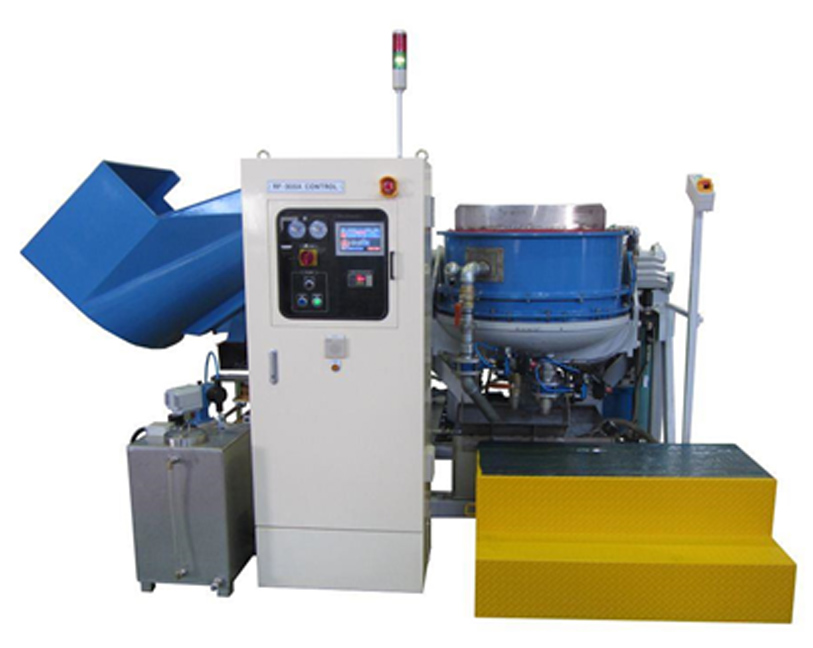
The Automated RF-Series converts centrifugal disc finishing into an unattended production cell. Unlike manual RF models (RF-20 through RF-200), which require loading, monitoring, unloading, separating, and washing, these systems automate the entire process—leaving the operator to simply load raw parts and remove finished ones.
Available in RF-100A, RF-200A, RF-300A, and RF-400A models, capacities range from 3 to 12.1 cubic feet. Each system integrates automated loading with weight verification, adjustable-speed finishing, media separation, and parts washing in a single PLC-controlled workflow. Operators set parameters on a touchscreen, and the machine handles the rest.
For manufacturers where manual handling is the bottleneck, the Automated RF-Series can effectively double productive finishing time. It also frees operators to manage multiple machines at once.
The Automated Workflow: From Raw Parts to Finished, Washed Components
Here’s what happens when you press “Start” on an Automated RF-Series machine:
- Step 1 — Automated Loading: Parts are loaded into the system’s hopper or loading station. The system weighs the batch to verify the correct part-to-media ratio, then feeds parts into the finishing drum automatically.
- Step 2 — Centrifugal Disc Finishing: The rotating disc drives parts and media in the same high-energy toroidal flow as the manual RF machines. Speed and cycle time are controlled by the PLC recipe. Adjustable from heavy grinding to fine polishing.
- Step 3 — Automated Media Separation: When the finishing cycle completes, the built-in media separator automatically separates parts from media. Media is returned to the drum for the next cycle. Parts move to the washing station. No manual sorting.
- Step 4 — Automated Parts Washing: Finished parts are washed automatically, removing compound residue, metal fines, and media dust. Parts exit the system clean and ready for inspection, coating, or assembly.
- Step 5 — Ready for Next Batch: Because media is automatically returned to the drum and the system self-cleans, the machine is ready for the next batch immediately. Continuous operation with minimal operator intervention.
The entire process—from raw parts in to clean, finished parts out—runs on a single PLC recipe. Once validated, the recipe delivers identical results batch after batch, shift after shift, operator after operator.
Key Features
- Automated loading, weighing, finishing, separating, and washing processes streamline operations.
- Adjustable cutting and finishing speeds provide flexibility and control.
- The PLC touchscreen interface ensures user-friendly operation and precise parameter settings.
Standard Features
- PLC Controls
- Variable Frequency Drive
- Digital Process Timer
- Polyurethane Lined
- Upflow Drain System (water is pushed up thru disc gap & drains toward top of machine)
- Finish Cycle Buzzer
- Ideal Unload Height
- Convenient Operator Control Console
- Hydraulic Disc Unload
- Variable Process Timer
- Amp Meter
- RPM Meter
What Automation Adds Over the Manual RF-Series
|
Automated loading with weigh verification Parts are fed from a hopper into the drum automatically, with integrated weighing to verify the correct batch size. This eliminates operator guesswork on part-to-media ratios and ensures every batch is loaded consistently—a requirement for validated finishing processes. |
Built-in media separator At the end of each cycle, media is automatically separated from parts and returned to the drum. No manual dumping, no hand-sorting. This is the single biggest time-saver over the manual machines—media sorting typically consumes as much operator time as the finishing cycle itself. |
|
Integrated parts washing Finished parts are washed automatically before exiting the system. Compound residue, metal fines, and media dust are removed without a separate washing step. Parts come out clean and ready for inspection, coating, or assembly—eliminating the manual wash station from your production flow. |
PLC touchscreen control with recipe storage Every process parameter—finishing speed, cycle time, separation settings, wash duration—is stored as a recipe on the PLC touchscreen. Operators select the recipe and press start. This ensures identical results regardless of which operator runs the machine and eliminates the per-batch setup that manual machines require. |
|
One operator, multiple machines Because the automated cycle runs unattended, a single operator can manage two or three Automated RF machines simultaneously—loading one while the others run. This reduces the labor cost per finished part and allows finishing departments to scale throughput without adding headcount. |
Continuous operation with media return Media is automatically returned to the drum after separation, so the machine is ready for the next batch immediately. There’s no manual media refill step between cycles. For operations running back-to-back batches across a full shift, this eliminates the dead time that manual machines accumulate between cycles. |
Automated RF-Series Centrifugal Disc Basic Operation
Operating the Automated RF-Series Centrifugal Disc Finisher is straightforward. Load the barrel manually with media, parts, and compound. Set your parameters on the PLC controller, set it to “auto mode”, and press the machine start button to initiate the automated process. The Automated RF-Series Centrifugal Disc machines have automated loading, weighing, finishing, separating, and washing processes.
Four Automated Models: RF-100A Through RF-400A
|
Spec |
RF-100A |
RF-200A |
RF-300A |
RF-400A |
|
Capacity |
3 cu ft |
6 cu ft |
(Verify) |
12.1 cu ft |
|
Manual Equivalent |
RF-100 |
RF-200 |
(No manual equiv.) |
(No manual equiv.) |
|
Motor |
5 HP (est.) |
7.5 HP (est.) |
(Verify) |
(Verify) |
|
Best For |
Entry automation; RF-100 upgrade path |
Mid-volume automation; RF-200 upgrade path |
Higher volume; no manual alternative |
Highest volume; largest automated disc finisher |
RF-100A: The entry point to automated disc finishing. Same drum and motor as the manual RF-100 (3 cu ft, 5 HP), with full automation added. The most common choice for shops upgrading from a manual RF-100 that has proven the process.
RF-200A: Double the RF-100A’s capacity. Same drum and motor as the manual RF-200 (6 cu ft, 7.5 HP). For operations that need both high capacity and full automation.
RF-300A: An automated-only model with no manual equivalent. For operations that need more capacity than the RF-200A without stepping up to the RF-400A.
RF-400A: The largest automated centrifugal disc finisher Mass Finishing makes. At 12.1 cubic feet, it’s the flagship of the entire RF-Series lineup—manual or automated. For the highest-volume finishing operations.
When Does Automation Make Sense?
Automation isn’t always the right answer. For some operations, a manual RF machine is more cost-effective and perfectly adequate. Here’s how to think about the decision:
Automate When…
- Manual load/unload time approaches or exceeds finishing cycle time. If your finishing cycle is 15 minutes but loading, dumping, sorting, and washing takes another 15, you’re spending half your machine time on material handling. Automation eliminates most of that overhead.
- You’re running high batch counts per shift. Operations running 10–20+ batches per day accumulate significant manual handling time. Automation compounds the time savings across every cycle.
- Labor cost is a significant factor. If an operator is dedicated to the finishing machine full-time, automation frees them for other tasks—or allows one operator to run multiple finishing cells.
- Process consistency is critical. Automated loading with weigh verification and PLC recipe control eliminates the batch-to-batch variability that manual loading introduces. For quality-critical applications (medical, aerospace, automotive), this consistency supports process validation requirements.
Stay Manual When…
- Your batch count is low. Operations running 3–5 batches per day may not generate enough manual handling time to justify the automation investment.
- Your part mix changes frequently. Manual machines offer more flexibility for quick changeovers between different part types, media configurations, and cycle parameters. Automation is most efficient when running the same recipe repeatedly.
- Budget is the primary constraint. Manual RF machines cost significantly less than their automated counterparts. For many small and medium shops, the manual RF-100 or RF-200 delivers excellent finishing performance at a lower price point.
- You’re still evaluating the process. Start with a manual machine to validate your finishing process, then upgrade to the automated version once you’ve confirmed the results. Processes transfer directly from manual to automated because the drum and motor are the same.
Who Uses the Automated RF-Series
- High-volume production manufacturers in automotive, aerospace, medical, and industrial equipment sectors where finishing is a daily, multi-shift operation. The automated workflow eliminates the labor bottleneck that limits manual machine throughput.
- Contract manufacturers and job shops at scale that finish thousands of small parts per day across multiple customer orders. Automation reduces per-part labor cost and improves turnaround time.
- Manufacturers with quality validation requirements (FDA, AS9100, ISO) where batch-to-batch consistency is documented and audited. The PLC recipe system and automated weigh verification provide the process traceability that quality systems demand.
- Operations looking to reduce finishing headcount without reducing throughput. One operator managing two or three automated cells replaces two or three operators running individual manual machines.
- Companies upgrading from manual RF-100 or RF-200 machines that have already validated their finishing process. The upgrade path is seamless—same drum, same motor, same process parameters.
Are You Interested in the Automated RF-Series?